

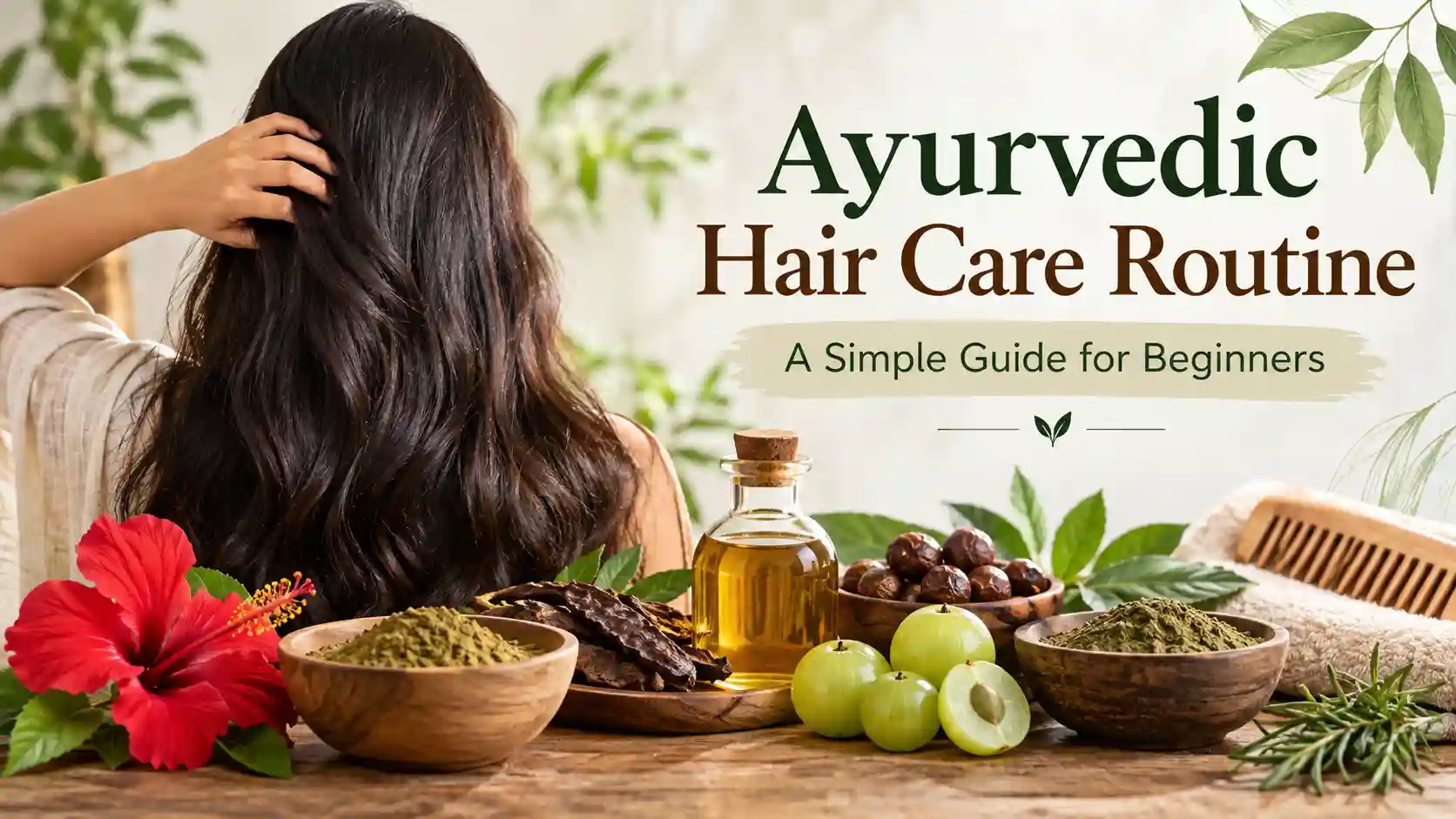
Ayurvedic Hair Care Routine: A Simple Guide for Beginners
Healthy-looking hair doesn’t always require a complicated routine with a long list of products. Ayurveda has traditionally emphasized simple, consistent self-care using plant-based ingredients and mindful routines.
For beginners, the easiest approach is to start with a few practical habits: keep the scalp and hair clean, avoid excessive manipulation, choose suitable ingredients, and follow a routine consistently.
In this guide, we’ll explore a simple Ayurvedic hair care routine for beginners, how traditional herbal ingredients such as amla, bhringraj, hibiscus, shikakai, reetha and rosemary are commonly used, and how you can create a routine that fits your lifestyle.
Important: Ayurvedic herbs have a long history of traditional use, but traditional use should not be interpreted as proof that an ingredient can treat or cure a medical condition. Hair loss, persistent scalp irritation, severe dandruff or other ongoing scalp concerns may require advice from a qualified dermatologist or healthcare professional.
What Is an Ayurvedic Hair Care Routine?
An Ayurvedic hair care routine is a traditional approach to hair and scalp care that focuses on regular cleansing, conditioning, oiling and the use of botanical ingredients.
Unlike a complicated product-heavy routine, an Ayurvedic-inspired routine can be relatively simple.
The basic idea is:
Cleanse → Nourish → Care → Repeat consistently
The exact routine can vary depending on your hair type, scalp condition, lifestyle and personal preferences.
For a beginner, consistency is generally more useful than trying several new ingredients at once.
Why Choose an Ayurvedic-Inspired Hair Care Routine?
Traditional Indian hair care has long included plant-based ingredients and simple practices such as hair oiling, herbal cleansing and botanical hair packs.
Ingredients such as amla, bhringraj, hibiscus, shikakai and reetha are commonly associated with traditional hair care practices.
One benefit of keeping your routine simple is that it becomes easier to understand how your hair and scalp respond to individual products.
Instead of changing everything at once, you can introduce one ingredient or product at a time and observe how your hair responds.
7 Simple Steps for an Ayurvedic Hair Care Routine
1. Understand Your Hair and Scalp First
Before choosing herbal ingredients, understand your starting point.
Ask yourself:
- Is my scalp generally oily, dry or somewhere in between?
- Does my hair feel dry after washing?
- Is my hair straight, wavy, curly or coily?
- How frequently do I wash my hair?
- Do I use heat styling or chemical treatments?
- Is my scalp comfortable between washes?
There is no single Ayurvedic hair care routine that works identically for everyone.
Your routine should be adjusted according to your individual hair and scalp needs.
For example, someone with a dry scalp may prefer a gentler cleansing routine, while someone with an oily scalp may need more frequent cleansing.
2. Keep Your Scalp Clean
Cleansing is one of the foundations of any hair care routine.
Sweat, excess oil, dust, styling products and environmental buildup can accumulate on the scalp and hair.
Choose a cleansing method that suits your hair and scalp rather than washing simply because a particular schedule is popular online.
Traditional herbal ingredients such as shikakai and reetha have historically been used for hair cleansing.
However, herbal does not automatically mean suitable for everyone. Introduce new ingredients gradually and stop using them if you experience irritation.
Beginner Tip
If you are completely new to herbal hair care, don’t immediately replace every product in your routine.
Start by introducing one herbal product at a time.
That makes it easier to understand what works for you.
3. Consider Traditional Hair Oiling
Hair oiling is one of the most recognizable practices associated with traditional Indian hair care.
The practice generally involves applying a suitable hair oil to the scalp and/or lengths of the hair, followed by gentle massage.
A simple approach is:
- Take a small amount of suitable hair oil.
- Apply it gently rather than soaking the scalp.
- Massage using your fingertips.
- Leave it for a period that is comfortable for you.
- Wash your hair with a suitable cleanser.
Avoid aggressive scratching or vigorous massage, especially if your scalp is sensitive.
Hair oiling can also be useful as a relaxing self-care ritual, but it should not be presented as a guaranteed treatment for hair loss or other scalp conditions.
4. Add Herbal Ingredients Gradually
One of the biggest mistakes beginners make is trying five or six new ingredients at the same time.
Instead, start with one.
Some traditional hair care ingredients include:
Amla
Amla Powder is commonly used in traditional Indian hair care and is available as a powder that can be incorporated into hair packs or other routines.
Bhringraj
Bhringraj Powder has a long history of traditional use in Ayurvedic hair care practices and is commonly used in herbal hair preparations.
Hibiscus
Hibiscus flowers and leaves Powder have traditionally been incorporated into hair care preparations, including homemade hair packs.
Shikakai
Shikakai Powder is traditionally associated with herbal hair cleansing.
Reetha
Reetha, also known as soapnut, has traditionally been used as a natural cleansing ingredient.
Rosemary
Rosemary is another botanical commonly found in modern natural hair care routines and can be used in preparations such as hair rinses.
The important point is not to use every ingredient simply because it is popular.
Choose ingredients based on your routine, preferences and tolerance.
5. Try a Simple Herbal Hair Pack
Herbal hair packs can be an occasional addition to your routine.
For example, beginners can explore a simple preparation using a single herbal powder rather than immediately creating a complicated mixture.
Simple approach
- Place a small amount of herbal powder in a clean bowl.
- Add enough water to create a smooth paste.
- Mix thoroughly.
- Apply according to the ingredient’s intended use.
- Leave it on for a comfortable period according to the product instructions.
- Rinse thoroughly.
- Follow with your normal hair care routine if needed.
Always follow the instructions supplied with the particular product you purchase.
Patch Testing
If you are trying a new botanical ingredient, consider testing a small amount on a limited area of skin first.
If redness, burning, itching or other irritation occurs, discontinue use.
6. Don’t Ignore Your Hair Lengths
Hair care isn’t only about the scalp.
The lengths and ends of the hair can become dry or damaged from:
- Heat styling
- Frequent coloring
- Chemical treatments
- Excessive brushing
- Environmental exposure
- Mechanical friction
Be gentle while washing and drying your hair.
Avoid rubbing wet hair aggressively with a towel.
Instead, gently squeeze out excess water and handle the hair carefully.
A wide-tooth comb can also be useful for detangling, particularly when the hair is prone to knots.
7. Make Consistency Your Priority
You don’t need a 10-step routine.
A beginner-friendly Ayurvedic-inspired routine could look like this:
Weekly Routine
1–2 times per week
Hair oiling, if suitable for your scalp and hair.
Wash days
Cleanse the scalp and hair with a suitable product.
Occasionally
Use an herbal hair pack if it suits your routine.
Daily
Handle your hair gently and minimize unnecessary heat or mechanical stress.
The exact frequency should depend on your hair type, scalp, lifestyle and the products you use.
Best Ayurvedic Herbs for Hair Care
Here is a simple overview of popular traditional ingredients:
| Ingredient | Traditional Hair Care Use |
| Amla | Commonly used in traditional hair preparations |
| Bhringraj | Traditionally used in Ayurvedic hair care |
| Hibiscus | Used traditionally in hair packs and preparations |
| Shikakai | Traditionally used for cleansing |
| Reetha | Traditionally used as a cleansing ingredient |
| Henna | Traditionally used for hair conditioning and coloring |
| Indigo | Traditionally used alongside henna for hair coloring |
| Rosemary | Commonly used in modern botanical hair care |
Remember that traditional use does not automatically establish a medical benefit. Individual responses can also vary.
A Simple Ayurvedic Hair Care Routine for Beginners
If you’re overwhelmed by all the different ingredients available, start here.
Step 1: Choose a suitable cleanser
Use a hair cleanser that works comfortably with your scalp and hair type.
Step 2: Introduce oiling
If your scalp tolerates it, try a simple oiling routine before washing.
Step 3: Choose one herbal ingredient
Start with something simple such as amla, bhringraj or hibiscus.
Step 4: Use it occasionally
You don’t need to apply herbal powders every day.
Step 5: Observe your hair
Pay attention to how your scalp and hair feel after using the ingredient.
Step 6: Adjust your routine
If your hair feels dry, your routine may need more gentle conditioning and less frequent cleansing.
If your scalp becomes irritated, stop using the new ingredient.
Ayurvedic Hair Care Routine According to Hair Type
For Dry Hair
Consider focusing on:
- Gentle cleansing
- Regular conditioning
- Suitable hair oiling
- Minimizing excessive heat
- Gentle detangling
Avoid repeatedly using harsh cleansing methods that leave your hair feeling stripped.
For Oily Scalp
Consider:
- Regular scalp cleansing
- Avoiding excessive oil application
- Washing according to your scalp’s needs
- Keeping heavy styling products under control
You don’t necessarily need to avoid oils completely, but excessive application may not feel comfortable for every oily scalp.
For Normal Hair
You can generally focus on maintaining a balanced routine:
- Regular cleansing
- Occasional oiling
- Gentle handling
- Occasional herbal hair packs
- Minimal heat damage
For Curly or Wavy Hair
Curly and wavy hair can be more prone to dryness and tangling.
Consider:
- Gentle cleansing
- Adequate conditioning
- Minimal brushing when dry
- Gentle detangling
- Avoiding excessive heat
Your hair’s texture should guide your routine rather than following a one-size-fits-all approach.
Common Ayurvedic Hair Care Mistakes Beginners Should Avoid
1. Using Too Many Ingredients
More ingredients don’t necessarily mean better results.
Start with one or two products.
2. Leaving Every Product on for Too Long
Longer application doesn’t automatically make a product more effective.
Follow the manufacturer’s directions.
3. Applying Excessive Oil
A large amount of oil isn’t necessary for everyone.
Use an amount that works for your hair and scalp.
4. Scrubbing the Scalp Aggressively
The scalp should be treated gently.
Avoid scratching or vigorous rubbing.
5. Expecting Instant Results
Hair care is generally a process of consistent maintenance.
Avoid judging a routine after just one application.
6. Ignoring Persistent Problems
If you have significant hair loss, persistent itching, inflammation, painful scalp lesions or other ongoing symptoms, don’t rely solely on home remedies.
Consult a qualified healthcare professional or dermatologist.
How to Build Your Own Ayurvedic Hair Care Routine
You can keep the process simple.
Your basic routine can be:
Cleanse
↓
Condition
↓
Oil if suitable
↓
Use one herbal ingredient occasionally
↓
Protect your hair
↓
Repeat consistently
The goal isn’t to create the most complicated routine.
The goal is to create a routine you can realistically maintain.
Frequently Asked Questions
What is the best Ayurvedic hair care routine for beginners?
A simple routine can include gentle cleansing, suitable conditioning, optional hair oiling and occasional use of a traditional herbal ingredient such as amla or bhringraj. Start gradually and adjust according to your hair and scalp.
How often should I follow an Ayurvedic hair care routine?
There is no universal schedule. Washing and treatment frequency depends on your scalp, hair type, lifestyle and the products you use.
Which Ayurvedic herbs are commonly used for hair care?
Amla, bhringraj, hibiscus, shikakai, reetha and henna are among the traditional ingredients commonly associated with Indian hair care.
Can beginners use herbal hair powders?
Yes, beginners can explore herbal hair powders, but it is better to introduce one ingredient at a time and follow the product instructions.
Can I use multiple herbal powders together?
You can find traditional combinations containing multiple herbs, but beginners may find it easier to start with one ingredient so they can understand how their hair and scalp respond.
How long should I leave a herbal hair pack on?
Follow the instructions for the specific product or preparation. Avoid assuming that leaving a product on longer will necessarily produce better results.
Should I oil my hair before washing?
Hair oiling is a traditional practice that some people include before washing. Whether it suits you depends on your scalp, hair type and personal preference.
Can Ayurvedic hair care stop hair loss?
Ayurvedic hair care should not be presented as a guaranteed treatment for hair loss. Hair loss can have many possible causes. Persistent or significant hair loss should be evaluated by a qualified healthcare professional.
Final Thoughts
An Ayurvedic-inspired hair care routine doesn’t need to be complicated.
Start with the basics: understand your hair and scalp, cleanse appropriately, handle your hair gently, consider traditional practices such as oiling, and introduce herbal ingredients gradually.
Ingredients such as amla, bhringraj, hibiscus, shikakai, reetha and henna have long-standing connections with traditional Indian hair care, and they can be explored as part of a simple personal-care routine.
Most importantly, focus on consistency rather than complexity.
Your ideal routine is one that suits your hair, fits your lifestyle and is easy enough to maintain over time.
Explore Satvayu Organics’ Hair Care and Herbal Powders collections to discover botanical ingredients that can complement a simple, Ayurvedic-inspired hair care routine.
Disclaimer: This article is intended for general educational purposes and discusses traditional hair-care practices. It is not medical advice and does not diagnose, treat, cure or prevent any disease or medical condition. Always follow product-specific instructions and seek professional advice for persistent scalp or hair concerns.
